



Artificial Intelligence is reshaping the world at an unprecedented pace. From revolutionizing healthcare to transforming industries, recent breakthroughs in AI technology are pushing the boundaries of what’s possible. These advancements not only enhance efficiency but also unlock new opportunities for innovation across various sectors.
As AI systems become more sophisticated, they’re capable of performing tasks that once seemed exclusive to human intelligence. This evolution raises fascinating questions about the future of work, ethics, and the role of technology in daily life. Understanding these breakthroughs is crucial for anyone looking to navigate the rapidly changing landscape of AI.
Overview of AI Breakthroughs
Artificial Intelligence (AI) breakthroughs influence diverse industries, reshaping processes and productivity. These advancements fall into several categories:
- Machine Learning Algorithms
Machine learning algorithms analyze vast datasets, uncovering patterns and insights. Applications include predictive analytics in finance and customer segmentation in marketing.
- Natural Language Processing (NLP)
Natural Language Processing enhances communication between humans and machines. NLP powers virtual assistants like Siri and chatbots that improve customer service experiences.
- Computer Vision
Computer vision enables machines to interpret and understand visual information. This technology underpins facial recognition systems and automated inspection in manufacturing.
- Robotics and Automation
Robotics integrates AI for automated tasks in various sectors. Automated guided vehicles (AGVs) in warehouses streamline operations and reduce labor costs.
- Generative AI
Generative AI creates new content, such as images, text, and music. Examples include AI-generated art and writing tools that assist in content creation.
- Reinforcement Learning
Reinforcement learning teaches systems to make decisions through trial and error. It applies to areas like game playing and optimizing logistics networks.
AI breakthroughs not only drive efficiency but also address complex problems across healthcare, finance, and transportation. Understanding these advancements is crucial for businesses aiming to leverage AI’s full potential.
Historical Context
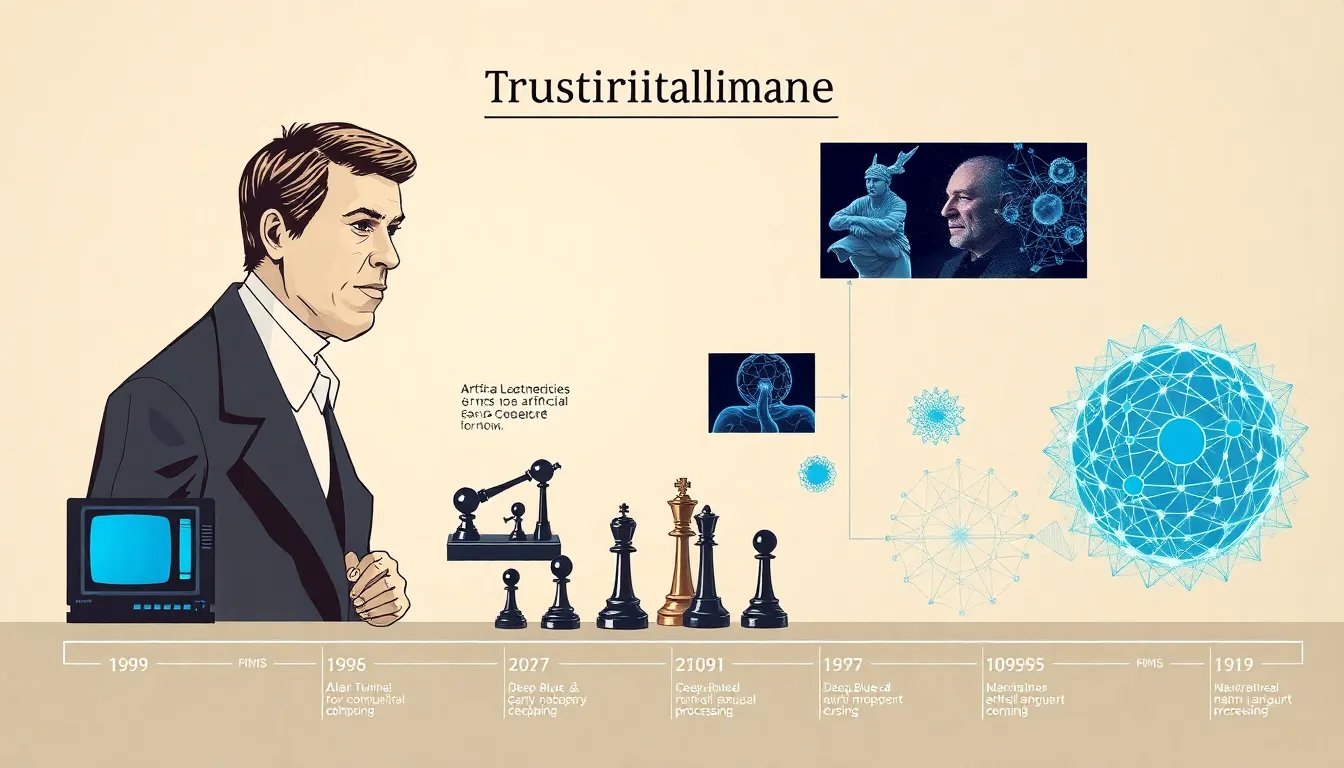
AI’s evolution traces back several decades, marked by critical discoveries and advancements that set the foundation for today’s technologies. Understanding these historical milestones provides valuable insight into the current landscape and future potential of artificial intelligence.
Early Developments in AI
Early developments in AI began in the 1950s, laying the groundwork for future innovation. Notable figures such as Alan Turing introduced pivotal concepts like the Turing Test, assessing a machine’s ability to exhibit intelligent behavior. In 1956, the Dartmouth Conference symbolized the birth of AI as a formal field, bringing together researchers to discuss machine intelligence. During this period, researchers focused on symbolic AI, using rules and logic to solve problems. Innovations in heuristics paved the way for algorithm improvements, despite limitations in computational power.
Landmark Moments in AI History
AI history features significant breakthroughs that shaped its trajectory:
- 1970s Rise of Expert Systems: Development of expert systems like MYCIN demonstrated AI’s potential in specific domains, such as medical diagnosis.
- 1980s AI Winter: A decline in funding and interest characterized the AI winter, driven by unmet expectations and technological limitations.
- 1997 Deep Blue’s Chess Victory: IBM’s Deep Blue defeated world champion Garry Kasparov, showcasing AI’s capability in strategic thinking.
- 2000s Expansion of Machine Learning: Increased computational resources and data availability led to substantial advancements in machine learning algorithms, driving AI’s resurgence.
- 2012 Breakthrough in Deep Learning: AlexNet’s performance in the ImageNet competition illustrated the power of deep learning, significantly enhancing computer vision tasks.
- 2018 Advancements in NLP: The release of BERT by Google transformed natural language processing capabilities, enabling machines to understand context more effectively.
Each of these moments represents a step forward in AI, illustrating a journey of resilience and innovation that continues to evolve in the modern digital landscape.
Recent Innovations
Recent breakthroughs in AI showcase significant advancements across various fields. These innovations enhance functionality, improve user experience, and optimize processes in numerous industries.
Natural Language Processing Advancements
Natural Language Processing (NLP) continues to evolve, facilitating seamless interaction between humans and machines. Advances in conversational AI enable chatbots and virtual assistants to comprehend and generate human-like responses. Tools like OpenAI’s GPT-4 demonstrate enhanced contextual understanding, allowing for more refined dialogue. Enhanced sentiment analysis techniques allow businesses to gauge customer feedback accurately. Additionally, NLP applications in translation software have become more sophisticated, improving accuracy and fluency in multiple languages.
Machine Learning and Deep Learning Breakthroughs
Machine Learning (ML) and Deep Learning (DL) see rapid progression, enabling systems to analyze data more effectively. Innovations like autoML automate the process of hyperparameter tuning, reducing the time experts spend on model optimization. Frameworks such as TensorFlow and PyTorch support more complex models and faster training times. Transfer learning models, like BERT and GPT, allow for leveraging pre-trained models on new tasks, enhancing performance with limited data. These breakthroughs in ML and DL open doors for deeper insights, predictive analytics, and automation in sectors ranging from finance to healthcare.
Applications of AI Breakthroughs
AI breakthroughs manifest prominently in diverse fields, enhancing operations, productivity, and decision-making. Several key areas illustrate the profound impact of these advancements.
Healthcare Transformations
AI catalyzes significant shifts in healthcare delivery and patient outcomes. Algorithms analyze medical images, improving diagnostic accuracy for conditions like cancer. Predictive analytics streamline patient management by forecasting disease progression, enabling timely interventions. AI-driven tools assist in developing personalized treatment plans by evaluating individual patient data and genetic information. Virtual health assistants and chatbots enhance patient engagement, providing immediate access to medical advice and resources, thereby reducing the burden on healthcare professionals.
AI in Business and Industry
AI applications revolutionize business and industrial processes. Machine learning algorithms optimize supply chain logistics, improving inventory management through demand forecasting. Automation tools reduce operational costs by streamlining manufacturing processes and enhancing workflow efficiency. Customer insights derived from AI analytics enable targeted marketing strategies, boosting sales and customer satisfaction. Fraud detection systems harness AI to identify and prevent suspicious activities, safeguarding financial transactions. AI’s role in predictive maintenance ensures equipment reliability, minimizing downtime and operational disruptions across various sectors.
Future Prospects of AI Breakthroughs
AI breakthroughs promise significant advancements across various sectors, necessitating an exploration of ethical considerations and potential challenges.
Ethical Considerations
Ethical considerations in AI development include concerns about privacy, bias, and accountability. Organizations must address data privacy issues as AI systems often require vast amounts of personal information for training. Instances of bias in algorithms can lead to unfair outcomes, impacting marginalized groups disproportionately. Transparency in AI decision-making processes ensures accountability, allowing users to understand the reasoning behind automated decisions. Stakeholders must prioritize ethical frameworks to guide responsible AI usage.
Potential Challenges
Potential challenges in AI advancements encompass technical limitations and societal implications. Technical challenges include the need for vast computational resources and high-quality datasets, complicating the development of robust AI models. Additionally, integrating AI into existing systems may face resistance from employees due to fears of job displacement. Societal implications, such as the digital divide, could widen gaps between those with access to AI technologies and those without. These challenges require thoughtful strategies to ensure equitable benefits from AI advancements.
AI breakthroughs are reshaping industries and redefining possibilities. As these technologies advance they offer innovative solutions that enhance efficiency and drive growth. The ongoing evolution of AI presents both opportunities and challenges that require careful consideration.
Organizations must stay informed about these developments to leverage AI effectively while addressing ethical concerns. A proactive approach to understanding AI’s implications will be crucial for navigating the future landscape. Embracing these advancements can empower businesses to thrive in an increasingly digital world, ensuring they’re well-prepared for the changes ahead.